
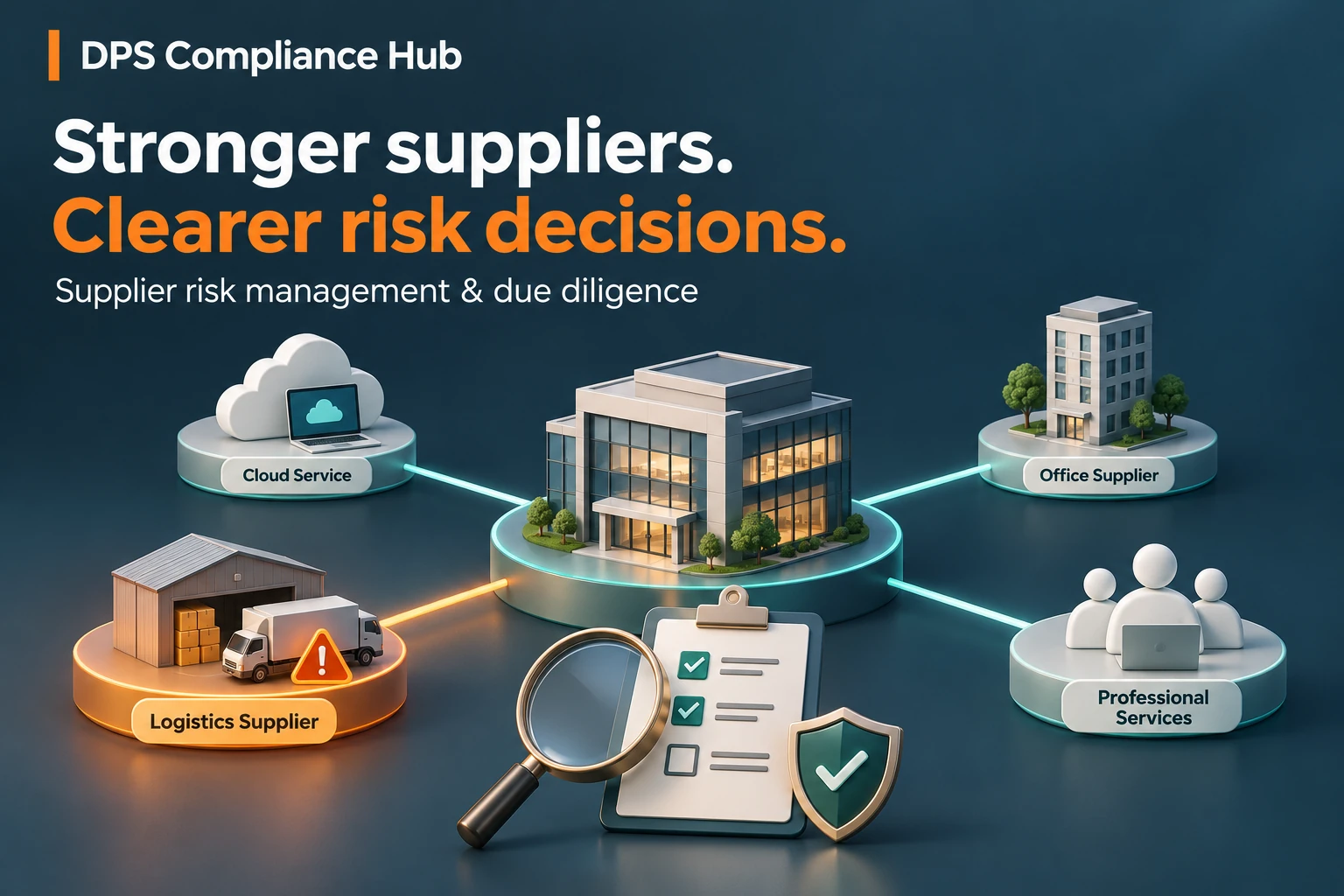
A cloud platform goes offline. An outsourced service provider exposes customer information. A critical supplier changes ownership or can no longer deliver. Each event starts outside your organisation, but the disruption, cost and loss of confidence can arrive at your door.
Effective supplier risk management helps you understand those dependencies and make informed decisions before problems become urgent. Combined with proportionate third party due diligence, it gives your organisation a clearer view of who it relies on, what could go wrong and what needs to happen next.
What is supplier risk management?
Supplier risk management is the ongoing process of identifying, assessing, treating and reviewing the risks associated with the organisations that supply your business. It covers the relationship from initial selection through delivery, renewal and exit.
Third party risk management takes a wider view, including partners, contractors and other external organisations whose activities could affect yours. Depending on the relationship, third party risks can include cyber security, privacy, operational disruption, financial instability, contractual weaknesses and reputational harm.
Due diligence is the investigation that supports a decision: checking the proposed service, asking relevant questions, reviewing evidence and identifying gaps. Risk management turns those findings into decisions, safeguards and follow-up. Both matter.
The benefits of effective supplier risk management
1. Protect the services your business depends on
Understanding supplier risk helps you identify the dependencies that would cause the greatest disruption. Which provider supports payroll, customer access, key records or essential operations? How long could you manage without that service?
Those questions help teams agree recovery expectations, contingency arrangements and practical alternatives. Looking at downstream providers can also reveal concentration risk: several suppliers may depend on the same cloud platform or specialist subcontractor.
2. Make better procurement decisions
A competitive price tells you little about the risk of a particular service. Third party due diligence adds context: what information the supplier will handle, what access it needs, how it protects the service and where its commitments fall short of your requirements.
This gives procurement and business owners a stronger basis for selecting suppliers, negotiating terms or applying conditions before onboarding. It can also reduce late surprises by identifying assurance requirements early in the buying process.
3. Protect information and support accountability
Supplier reviews help establish where information goes, who can access it and what safeguards apply. They also help identify unclear responsibilities for incident reporting, retention, deletion and subcontracting.
For organisations subject to UK GDPR, a controller appointing a processor must assess whether it offers sufficient guarantees, put the required processing terms in place and maintain appropriate oversight. The ICO’s guidance on controllers using processors explains why the assessment must consider the processing and the risk to individuals. A completed questionnaire alone does not establish compliance.
4. Use your team’s time more effectively
Not every supplier needs the same depth of review. A provider with privileged access to business systems presents a different exposure from an office supplier with no access to those systems.
Classifying suppliers by criticality, access, data sensitivity and dependency allows you to focus effort where it matters. Clear evidence requirements, named owners and review dates can reduce duplicated questions and repeated searches through email.
5. Make decisions easier to explain
Good risk management records the reasoning behind an approval, the evidence considered and any remaining uncertainty. It identifies who accepted the residual risk and what conditions or actions were agreed.
That history helps management, customers and auditors understand how supplier decisions were reached. It also makes handovers easier when staff or responsibilities change.
What should third party due diligence involve?
Start with the actual service and its business purpose. A supplier’s reputation or headline certification may be useful evidence, but you still need to check whether it covers the service, locations and activities relevant to your organisation.
- Define the relationship: record the service, business owner, criticality, access requirements and information involved.
- Assess relevant third party risks: consider security, privacy, service continuity, financial resilience and key subcontractor dependencies in proportion to the relationship.
- Review evidence: examine relevant assurance reports, certification scope and validity, policies, contractual commitments and recovery information. Record missing or unverified information explicitly.
- Resolve material gaps: request clarification, agree safeguards and set actions with owners and deadlines.
- Record the decision: approve, approve with conditions, defer or decline through the appropriate decision-maker, with a clear rationale.
- Plan ongoing review and exit: set review dates and change triggers, and consider how access, information and services will be handled when the relationship ends.
The NCSC recommends considering security across the contract lifecycle, from supplier selection through operation and termination. Its guidance on embedding cyber security controls in supplier contracts provides a useful foundation for this approach.
Turn findings into action
Consider a payroll provider that holds employee information but has not supplied adequate evidence of recovery testing. Recording “business continuity risk” is too vague to support a decision.
Example risk: There is a risk that if the payroll provider cannot restore its service before the payroll deadline, employees could be paid late and the organisation could face operational disruption and additional recovery costs.
The response might include requesting recovery evidence, checking contractual commitments, testing an alternative payroll procedure and assigning an owner to resolve outstanding questions. The authorised business decision-maker can then assess the remaining risk against the organisation’s tolerance.
This connects due diligence to a business outcome: a better-informed decision and a practical response to a credible problem.
Keep supplier assurance current
Supplier relationships change. A new service, expanded access, acquisition, incident or change in hosting arrangements may alter the original assessment. Evidence can also expire or cease to cover the service you use.
Combine scheduled reviews with reassessment triggered by meaningful changes. Useful measures include overdue high-priority actions, critical suppliers awaiting review, evidence requiring renewal and approvals that still have unresolved conditions. A low risk rating needs a current, explainable basis.
How the Supplier Risk Workspace helps
The DPS Compliance Hub Supplier Risk Workspace brings supplier assessments, evidence, risk decisions and follow-up into one structured place. It helps teams move from scattered questionnaires and documents to a process they can manage and explain.
Your team can use the workspace to:
- Organise supplier records and focus reviews on business context and criticality.
- Bring together supplier questionnaires, public-source checks and supporting evidence.
- Use AI-assisted analysis to support review, with authorised people validating the findings and decisions.
- Track actions, responsibilities, deadlines and evidence requiring renewal.
- Retain risk rationales, approval history and dated reports for management oversight.
Where internal capacity is limited, the DPS Supplier Risk Management service can coordinate agreed onboarding, questionnaire follow-up, evidence review and risk actions. The engagement defines responsibilities and decision authority, keeping accountability clear.
Software provides structure; effective supplier risk management also needs sound judgement and action. The value comes from understanding your exposure, challenging the evidence and keeping decisions current.
Arrange a Supplier Risk Workspace demonstration or talk to DPS about your supplier risk management and third party due diligence priorities.
Published 11 November 2026. Further reading: the NCSC guidance on collaborating with suppliers and partners and the ICO guidance linked above. The ICO flags that its processor guidance is under review following the Data (Use and Access) Act 2025. Legal requirements depend on the organisation and processing involved.